
Island Park Newspaper
Island Park News

VOLCANO LINKS 
 Stromboli Volcano 
 Mt. Kamchatkan 
 Mt. Pinatubo 
 Volcanos A-Z 

"SLIDE SHOW" 
Predicting
Volcanic
Eruptions
 

 Home Page 
 Activities 
 Calendar 
 I.P. History 
 Lodging 
 Maps 
 Weather 
 
Players Club
Member Login
 
 
Players Club
Join Today!
 
 
Island Park
Newsletter
 
 *Community
Organizations
 

 Unsubscribe
I.P. Newletter
 
Volcanic History of the Yellowstone

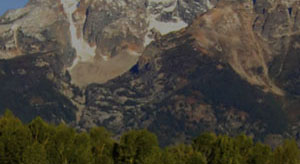
Aerial view of the striking NW rim of the Yellowstone caldera and intracaldera rhyolite lava flows at Madison Junction in Yellowstone National Park. View is looking north. The steep-facing caldera wall, 500 m tall, formed when the area in the...
foreground collapsed during eruption of the Lava Creek Tuff 640,000 years ago. The thick West Yellowstone rhyolite lava flow erupted about 110,000 years ago, and the Nez Perce Creek flow erupted 160,000 years ago.
Yellowstone's world-famous natural history is marked by such colossal volcanic events that their reflections in today's landscape are difficult to grasp and impossible to take in at just a glance, even for those familiar with the signs of past volcanism.
The stunning features of Yellowstone National Park result from great explosive eruptions and profound collapse of the ground, enormously thick lava flows, uplift and extensive faulting, and the erosive power of flowing water and ice. For more than a century, geologists have discovered and analyzed evidence of the dramatic events that have shaped the land here. When combined with growing knowledge about how volcanoes work and the never-ending motion of Earth's surface, the evidence tells a remarkable story of the Yellowstone landscape.
The volcanism most directly identified with the Yellowstone region has, during about the past 2 million years, built an immense volcanic plateau that straddles a high mountain divide—the Yellowstone Plateau volcanic field. This volcanic region has evolved through 3 cycles of voluminous outpourings of rhyolite lava and volcanic ash, each of them climaxing with one of Earth's greatest pyroclastic-flow eruptions and the resulting collapse of a central area to form a large caldera. Other eruptions have poured out basalt lava flows around the margins of the volcanic field.

Yellowstone & #39;s volcanism is only the most recent in a 17 million-year history of volcanic activity that has occurred progressively from southwestern Idaho to Yellowstone National Park. At least six other large volcanic centers along this path generated caldera-forming eruptions; the calderas are no longer visible because they are buried beneath younger basaltic lava flows and sediments that blanket the Snake River Plain.

Three Volcanic Cycles of Yellowstone

Overview:
Three extraordinarily large explosive eruptions in the past 2.1 million years each created a giant caldera within or west of Yellowstone National Park with the spread of enormous volumes of hot, fragmented volcanic rocks as pyroclastic flows over vast areas within times as short as a few days or weeks. The accumulated hot ash, pumice, and other rock fragments welded together from their heat and the weight of overlying material to form extensive sheets of hard lava-like rock. In some sections, these welded ash-flow tuffs are more than 400 m thick! These ash-flow sheets—from oldest to youngest, the Huckleberry Ridge, Mesa Falls, and Lava Creek Tuffs—account for more than half the material erupted from Yellowstone. The enormous outpouring of magma, 280 to 2,450 km3 during each explosive event, led to the collapse of magma-chamber roofs, causing the ground above to subside by many hundreds of meters to form the calderas.

Before and after these caldera-forming events, eruptions in the Yellowstone area produced rhyolitic and basaltic rocks—large rhyolite lava flows and some smaller pyroclastic flows in and near where the calderas collapsed and basalt lava flows around the margins of the calderas.

A general sequence of events was repeated in the evolution of each of Yellowstone's three volcanic cycles:

1. A broad area, larger than that which will become the caldera is slowly uplifted. This uplift reflects the development and rise of large volumes of rhyolite to form a magma chamber at shallow depths in the Earth's crust. Stretching of the crust above the inflating magma chamber leads to concentric and radial fracturing and faulting at the surface, typically accompanied by the extrusion of lava flows from these fractures.


2. At a critical stage in the evolution of the magma chamber, enormous volumes of the overpressurized rhyolite magma erupt explosively through the ring-fracture zone created above the magma chamber during inflation and uplift, producing extensive ash-flow sheets. As the eruptions partly empty the chamber of its magma, the roof of the magma chamber collapses along the same ring fractures to produce a large caldera.


3. Postcollapse volcanism includes the extrusion of rhyolite lavas and smaller explosive eruptions of pyroclastic flows within or adjacent to the the caldera. In the present-day Yellowstone caldera, lakes formed where streams draining into or along the margin of the caldera were dammed by these thick intracaldera rhyolite flows, including Shoshone, Lewis, Heart, and Yellowstone Lakes. Shortly following collapse, the caldera floor may be uplifted by hundreds of meters in a process known as resurgent doming; this uplift reflects renewed pressure as magma rises again into the magma chamber. Hydrothermal activity (such as hot springs and geysers) occurs during all three stages but, in the third stage, it becomes the dominant or only visible sign at the surface of magmatic activity below.

More Yellowstone Information
"Click Here"

For more information:
Island Park Reservations
P.O. Box 256
Island Park, ID 83429 US
Email: enchanted@islandparkidaho.com
(208) 558-9675

© Copyright 2007 Island Park Reservations. All Rights Reserved.